

Have you ever visited your website analytics and felt both excited and confused? You see traffic coming in, and people are evidently discovering your site. However, when you look at conversions such as demo requests or signups, the numbers don’t reflect that traffic. What’s happening?
This is one of the problems that most marketers are dealing with, particularly in SaaS. We invest time and money in SEO to scale up our rankings and attract more visitors. When we see those figures rise, it is a sense of success. Yet, these visitors don’t always convert to customers. They come, survey, and leave.
The first significant reason is that SEO and CRO tend to operate independently. One team is involved in attracting people. The other attempts to convert them. However, by not sharing insights, we lose sight of what truly matters: the user experience they have when they land on the site. We understand how they ended up there, but not why they failed to act.
That is where behavioral data is involved. It helps us understand user activity on the site, where they pause, and what they skip. When they leave, it provides us with clarity and transfers us out of speculation to knowledge.
And the numbers tell the story. Only one-fifth of the businesses indicate that they are happy with their conversion rates. In the meantime, firms with behavior-based approaches are experiencing more qualified leads and reduced expenses. The opportunity is clear.
Consider a B2B software firm that ranks among the top project management software firms. The page receives thousands of visitors monthly. However, less than one percent demand a demo. Without behavioral insights, the team is stagnant. Is the content unclear? Is the form too long? Something is lacking, and they cannot tell what.
This is what we are going to discuss in this blog. We will discuss the meaning of behavioral data, its effects on SEO and CRO, and what you can do with it today.
Read: Why Speed Can’t Save Your Back Office Processes from Chaos?
1. What Behavioral Data Really Means
Behavioral data reveals the interactions of people within your site. It records their activities, including their visits, the content they tap, and their navigation method. It makes you feel the experience as they do.
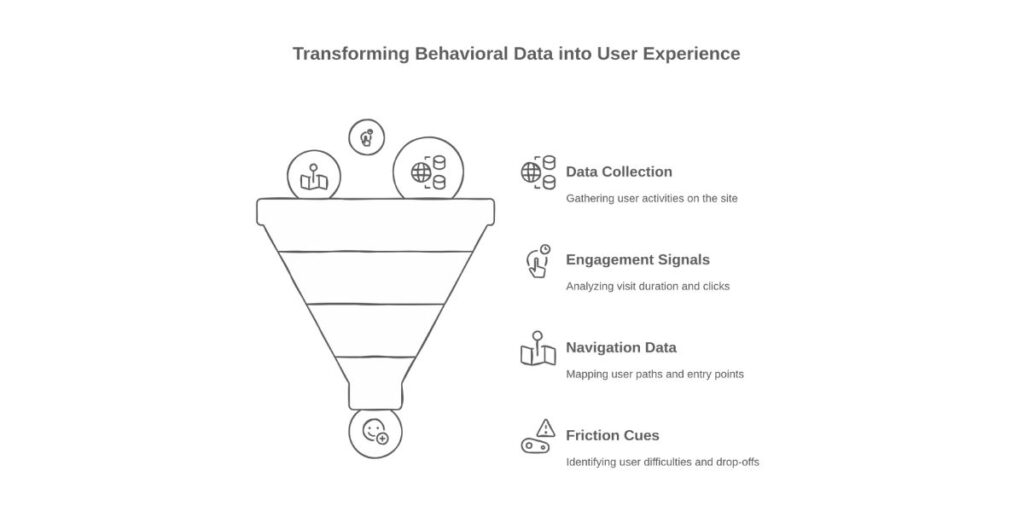
This data is presented in various forms and has several key components. First, there are engagement signals, such as duration of visit, scrolling distance, or the number of clicks. Next, there is the navigation data that records the routes followed by the users, such as their entry and exit points, and the pages they visit in between. And lastly, there are friction cues that indicate where the user is having difficulties such as clicking something repeatedly and not returning to something that does not work, leaving a form half completed or bouncing up and down pages without locating what they are looking at.
The beauty of this is that it eliminates guesswork with actual understanding. You no longer have to guess why a page is failing to convert, but can see where users are getting stuck or bored. You stop making changes based on what seems right and start making decisions based on what actually happens.
This is important because you don’t have much time to make an impression. The average amount of time spent on a page is 54 seconds. And the majority will not return when the experience is not smooth. Indeed, only a small percentage indicate that they are unlikely to make a second visit after a bad experience.
The companies that will act on this information will grow more rapidly. According to McKinsey, companies that utilize behavioral insights achieve higher sales and higher profits than their counterparts. It is not that they possess superior ideas. This is because they know their users better and design for them.
Take Amazon. The placement of reviews, the product recommendation, and the page structure are not arbitrary. It is influenced by the fact that millions of people are literally using the site. They observe behavior and let it guide the experience.
2. Using Behavioral Data to Improve SEO
Now that we have investigated what behavioral data is and why it is essential, the next question to ask is straightforward: how do we use it to achieve better results? Let’s start with SEO.
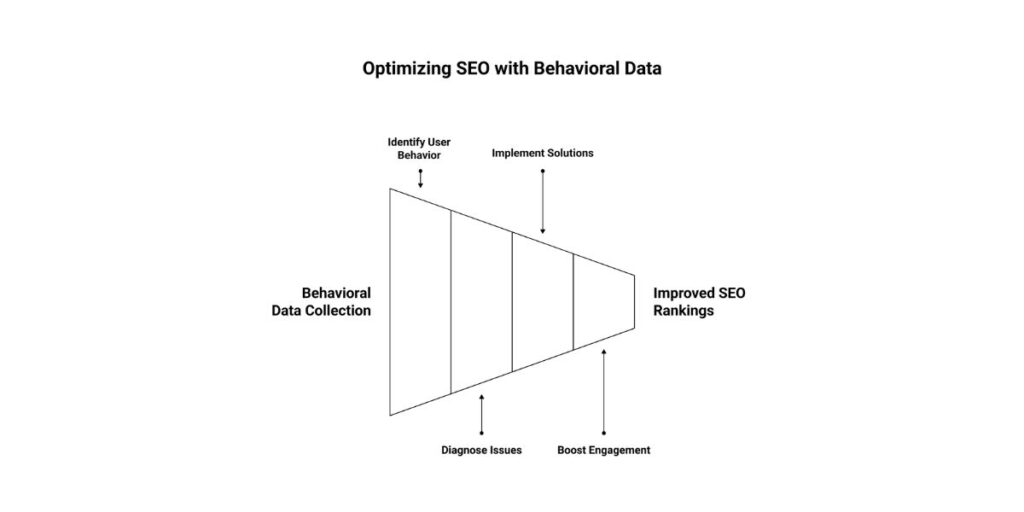
Search engines reward quality content that meets the needs of users. But how can you tell whether your content is doing that? Behavioral data will allow you to view how the users behave when they visit your page. It demonstrates whether they are getting what they need or are getting away too fast.
- Satisfying Search Intent:
When users jump up and down or only skim the first half of a page, it often indicates that the content isn’t responding to their query. That is what search engines pick up on. In the long run, these signals can influence your rankings. Thanks to heatmaps and scroll tracking, you can visually identify these drop-off points and optimize the page to make it more aligned with what people came to see. - Boosting Engagement Signals:
Behavioral insights can also keep visitors active. When you find people slowing down or halting on specific parts, you may enhance the flow by introducing some useful aspects. It can be a brief video, a more concise explanation, or internal links to related items. Such changes are likely to result in increased visit duration and improved search result performance. - Diagnosing and Fixing Pogo-Sticking:
Pogo-sticking occurs when the users come to your site and navigate back to the search results within a short time. This typically implies something out of place. The page may have taken too long to load or it failed to meet expectations as per the title. You can identify these problems at an early stage using the behavioral data. Observing user interactions helps you identify areas for improvement and safeguard your rankings.
This is not just theory. One such site, NerdWallet, once realized that individuals were jumping out of a trending article. A scroll map indicated that users were not reaching the tips at the bottom. The fix was simple. They placed major conclusions at the top and included a clickable table of contents. User interaction increased and rankings were high.
3. How Behavioral Data Drives Conversion Rate Optimization (CRO)
We have observed how behavioral data enhances search performance by matching users’ needs with what you offer. It is just the first step of attracting people to your site. That actual expansion occurs when those visitors act. This is where conversion rate optimization is applied and once again, behavioral data is put at the center of attention.
- Identifying Conversion Blockers:
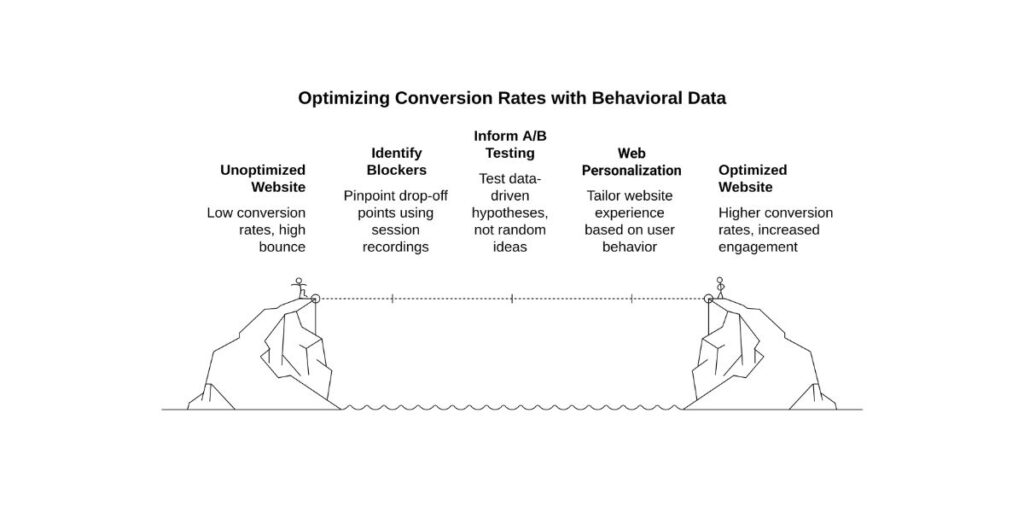
Spotting the precise spot at which users drop off is one of its most useful applications. By recording sessions, you can see how someone navigates a page and when they give up on a form or leave a cart behind. Something may have been unclear. The page layout may be out of place. Whatever the cause, you are not guessing; you are observing actual behavior. - Informing A/B Testing:
Such an insight is also what makes testing effective. You test what is already indicated by the data, rather than generating random ideas and running A/B tests. If users aren’t clicking on your main call to action, consider relocating it to a more prominent location. If they are hesitant about the pricing section, try simplifying it. Each change becomes more purposeful and more likely to work. - Web Personalization & CRO Platforms:
Most of the current personalization tools are also driven by behavioral data. Our Platforms, as well as Fragmatic, use this data to real-time tune websites. When a person visits your site as a result of browsing some of your features or product pages, the experience changes to show what is of the greatest importance to them. This is useful because it builds on what they have already shown interest in.
This strategy proves effective as companies that implement this often see higher returns and more effective marketing investments. When the experience is tailored to their needs, people tend to convert more frequently.
To illustrate, say a person has gone to an online shop such as ASOS and is browsing black running shoes. They visit again and their homepage features precisely that category, and similar products are given priority. It is smooth and deliberate. The user will find it easier to go on to the next step because of that simple shift which is made possible by behavior.
4. Building a Unified SEO + CRO Strategy
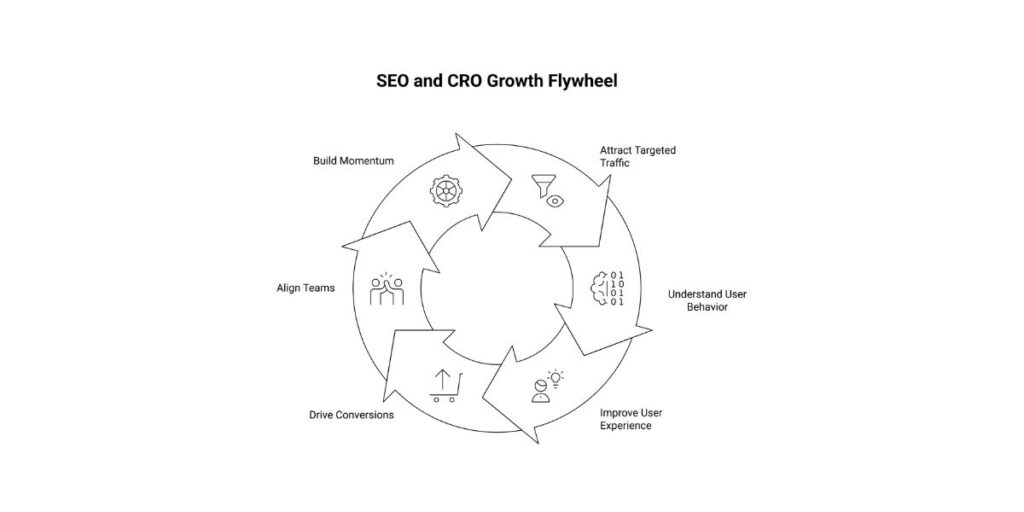
Having discussed how behavioral data can be used to enhance the performance of search and conversions, the next course of action would be to bring it all together. When both SEO and CRO collaborate, you will have something that is significantly more powerful: a growth flywheel.
Step 1: Attract with Targeted SEO
It begins with effective SEO, which attracts the right individuals to your site. There, behavioral data helps you understand how those visitors interact. You get to know what they are interested in, what makes them hesitate, and where they lose track.
Step 2: Understand Behavior to Find Gaps
With such insights, you can make improvements that lead the user more effectively to action. The experience is simplified, more understandable and valuable. The longer users remain on the site and the more they interact, the more the search engines can detect the signals and rank your content higher. That visibility attracts more of the appropriate traffic and the cycle is repeated.
Step 3: Improve Experience to Drive Conversions
One step of the process feeds another. The better you understand and act based on how the user behaves, the better the results. It is no longer about operating independent strategies. It is about creating a system that sustains all the actions.
Step 4: Align Teams Around a Shared Goal
To develop this work, teams must be oriented towards a common purpose. It is not only about being ranked higher or acquiring more conversions. The goal is to design an experience that makes it easier for users to locate what they need and proceed to the next step. SEO and CRO are expected to be linked together in terms of mutual tools, knowledge, and deliverables.
Step 5: Let the Flywheel Build Momentum
Businesses that adhere to this model can expand quickly and have more clients. Once the focus shifts to single strategy techniques to comprehensive journeys , everything is more efficient and effective.
Shopify is one such strategy. When they wanted to boost their signups to their free trial, they examined behavioral data and they found a hesitation towards the form. They added a short testimonial video, which allowed users to feel more confident. The conversion was enhanced and so was the retention of time on the page. The higher interaction contributed to getting the page ranked higher in search engines, attracting more qualified traffic.
Such a strategy generates momentum. It accumulates upon itself and becomes stronger. It all begins with understanding what your users are really doing.
Conclusion
The difference between SEO and CRO is where most growth silently drips out. Behavioral data bridges the gap. It exposes the interests of users, where they are reluctant and the reasons why they abandon. When marketers use it as their lens, they stop guessing and start designing experiences that drive results.
Start simple. Select a low-performing high-traffic page. Monitor user behavior by using a heatmap or a session recorder. Even ten sessions can reveal one noticeable improvement. That is the place where real momentum starts, as it encompasses behavior and simplifies the way users act.
Author’s Bio:
Vidhatanand is the Founder and CEO of Fragmatic, a web personalization platform for B2B businesses. He specializes in advancing AI-driven personalization and is passionate about creating technologies that help businesses deliver meaningful digital experiences.